Sharing the user experience - designing a form with the customer in mind
Archive - Originally posted on "The Horse's Mouth" - 2011-11-29 22:05:16 - Graham Ellis
I came across a business survey to fill in this morning. I started. Then I stopped, cleared it, and took it in to class - as an excellent demonstration of some of the issues that system designers should consider when they're designing a form, based on the thoughts of a user filling it in. Seven pages ... lets' look at the thirteen fourteen questions on the first of them.
Hmmm ... I wonder what the privacy position is on this lot? No statement. Wonder how much to enter into the "products and or services" box? Really not much of clue as to how much detail to go into.
OK - we have two business addresses. Do you want the HQ, or the larger other office where all our customers come for our services? Or both?
There are five of us full time. But - hand on - "I" employ 4 of them, the company employs 5. Even on this simple question I'm wondering which box I should be completing.
Chuckle. The survey gives its age straight away - it's been two months in the publishing
Oh look - we have a question 5.i - a sudden break in sequence. An afterthought?
Now that's a really odd one. We're not a parent, we're not a subsidiary - we're just a simple little company. How extraordinary that we have to enter "other" and explain!
Oh look - an English survey? "Real Estate activities?" "semi-trailers"? Alphabetic order, except for one "P" in the middle of manufacture. And I have a big problem here in what to answer. We're a hotel and training company. The two are symbiotic. which ONE answer should I choose?
I think this is really two questions in one. What sort of premises do you occupy, and what is the financial arrangement over it? Which question does "other" apply to, or should you only answer "other" if you can't answer either sub-question from the list?
A bit of calculation, then to be fair I found this one quite easy. Then my delegates pointed out that our car park and garden are very much a customer facing part of our business premises ... and that leads to a completely different response.
I'm in the IT business - and even I scratched my head about SDSL. And what's "Standard"? Or is that just there for a label to help the "don't know" people guess that's what they might have? We're fibre, but with mixed fibre / copper networks coming into play, I really doubt that everyone will know.
At last - a surprisingly easy one for us - no great problem in knowing what to say.
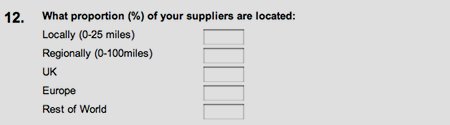
My natural instinct was to enter around 5% locally, then 35% in the region, 40% in the rest of the UK, 15% elsewhere in Europe and 5% in the rest of the world. But that's not the question! The actual answer should be 5% local, 40% region (it says from ZERO miles explicitly), 80% UK (it does NOT say outside the region) and 95% Europe (the UK is within Europe). 5% remains for rest of world.
Same comment as question 11. And in addition we buy smaller things locally (lots of small suppliers) and more expensive specialist items from further afield. Question is unclear to me on which way to answer. And what about the company I visit in Chippenham, and look at their stock. It's a small store, so we look in their full range catalog and as a result of the Chippenham visit order from their central online base in Lancashire. Major purchase. Local? UK?
And I'm astonished that I wasn't asked "and what are they". This question is rather like someone walking up to me in the street and asking "could you tell me the way to the Canal?" and me answering "yes, I could", without going on to give them directions.
I'm being something of a pedant here - but it's critically important to consider the user experience when designing a form, and it's important to consider what the answers will mean. With this survey, I found myself wondering "should I bother", and "I can't see how the results will be anything like as useful as they could have been". Rather sad, really, for the information here could form an excellent knowledge base of business characteristics in our local area.
Still - it made an excellent, real life, current example for me to teach - and on each question, the class and myself came up with excellent ideas as to how the survey could have been improved. It's a superb teaching example for me.
 Hmmm ... I wonder what the privacy position is on this lot? No statement. Wonder how much to enter into the "products and or services" box? Really not much of clue as to how much detail to go into.
 OK - we have two business addresses. Do you want the HQ, or the larger other office where all our customers come for our services? Or both?
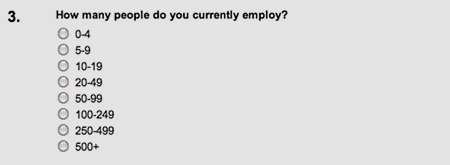 There are five of us full time. But - hand on - "I" employ 4 of them, the company employs 5. Even on this simple question I'm wondering which box I should be completing.
 Chuckle. The survey gives its age straight away - it's been two months in the publishing
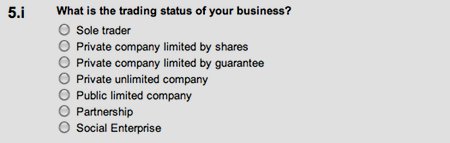 Oh look - we have a question 5.i - a sudden break in sequence. An afterthought?
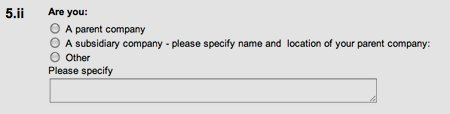 Now that's a really odd one. We're not a parent, we're not a subsidiary - we're just a simple little company. How extraordinary that we have to enter "other" and explain!
 Oh look - an English survey? "Real Estate activities?" "semi-trailers"? Alphabetic order, except for one "P" in the middle of manufacture. And I have a big problem here in what to answer. We're a hotel and training company. The two are symbiotic. which ONE answer should I choose?
 I think this is really two questions in one. What sort of premises do you occupy, and what is the financial arrangement over it? Which question does "other" apply to, or should you only answer "other" if you can't answer either sub-question from the list?
 A bit of calculation, then to be fair I found this one quite easy. Then my delegates pointed out that our car park and garden are very much a customer facing part of our business premises ... and that leads to a completely different response.
 I'm in the IT business - and even I scratched my head about SDSL. And what's "Standard"? Or is that just there for a label to help the "don't know" people guess that's what they might have? We're fibre, but with mixed fibre / copper networks coming into play, I really doubt that everyone will know.
 At last - a surprisingly easy one for us - no great problem in knowing what to say.
 My natural instinct was to enter around 5% locally, then 35% in the region, 40% in the rest of the UK, 15% elsewhere in Europe and 5% in the rest of the world. But that's not the question! The actual answer should be 5% local, 40% region (it says from ZERO miles explicitly), 80% UK (it does NOT say outside the region) and 95% Europe (the UK is within Europe). 5% remains for rest of world.
 Same comment as question 11. And in addition we buy smaller things locally (lots of small suppliers) and more expensive specialist items from further afield. Question is unclear to me on which way to answer. And what about the company I visit in Chippenham, and look at their stock. It's a small store, so we look in their full range catalog and as a result of the Chippenham visit order from their central online base in Lancashire. Major purchase. Local? UK?
 And I'm astonished that I wasn't asked "and what are they". This question is rather like someone walking up to me in the street and asking "could you tell me the way to the Canal?" and me answering "yes, I could", without going on to give them directions.